A Straightforward Guide to Slot Jackpots

I have dedicated enough time with slot reels to recognise that “jackpot” can mean vastly different things according to the game https://starburstdemo.eu/. On a progressive title, the top prize increases as players wager; on a fixed-top-prize game, the maximum payout remains constant. Starburst Slot is among the most recognised low-volatility slots in the UK, and even though it does not run a progressive pool, its payout structure offers a useful way to comprehend jackpot mechanics. I will describe fixed and progressive prizes, how Starburst Slot actually pays, and what you ought to check before betting real money. This is a guide concerning the game itself, not concerning any single casino site.
Fixed Jackpots: A Guaranteed Prize Pool
A determined jackpot is a prize amount that never changes, no matter how many people play or how long the game runs. It is commonly expressed as a multiple of your total bet, such as 1,000x, 5,000x or even 10,000x. I like fixed jackpots because they allow me calculate the maximum possible return before I place a single spin. If I am betting £1 per round and the top prize is 5,000x, I know the ceiling is £5,000. That transparency eliminates the guesswork and assists me determine whether the potential reward justifies the volatility I am about to face.
Fixed jackpots show up in many forms. Some are located right on the main paytable as the highest symbol combination, while others are hidden inside a bonus round or a special feature like a wheel spin. I have played games where the fixed grand prize only kicks in when you collect three jackpot symbols during free spins, which adds an extra layer of anticipation. The key point is that the prize amount is fixed and does not depend on contributions from other players. That makes fixed jackpot slots appear more self-contained and, in my experience, more straightforward to budget for because the maths never shifts mid-session.
How Fixed Jackpots Are Displayed
The majority of developers present the fixed jackpot amount directly on the paytable or in a special information screen. I always check whether the figure is shown as a cash value or a multiplier. A multiplier-based display, such as “5,000x bet,” is more common because it scales with your stake. If the game shows a static cash number, you need to confirm whether that amount applies only to a specific bet level. I once misread a paytable that displayed a £10,000 jackpot, only to realise it required a maximum bet of £20 per spin to qualify. That experience taught me to read the small print before celebrating.
Stake Multipliers vs. Fixed Amounts
When a jackpot is listed as a multiplier, your potential win grows proportionally with your bet. Bet £0.10 and a 5,000x prize becomes £500; bet £2 and it becomes £10,000. An absolute amount, on the other hand, stays fixed regardless of your stake, which can make low-stakes play disproportionately rewarding if you hit it. I prefer multiplier-based fixed jackpots because they reward higher risk with a larger absolute return, but I also appreciate the thrill of a flat prize that can turn a tiny bet into a meaningful sum. Both systems have their place, and I always verify which one a game uses before I commit any real money.
The way Starburst Slot Integrates With Jackpot Conversations
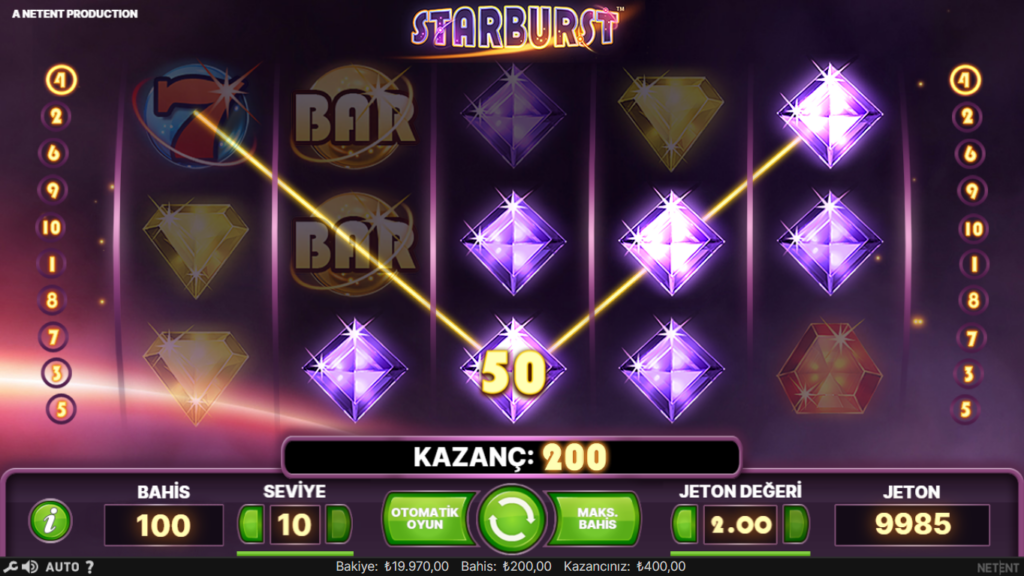
Starburst Slot is a 5-reel 3-row game from NetEnt with ten predetermined paylines and a payout structure built around regular line wins as opposed to a life-changing progressive sum. Many players seek “Starburst jackpot” anticipating a pooled prize that grows to the millions, but the game simply does not work that way. Its top single-spin win is capped at 500 times your stake when you fill the reels with wilds, and even that needs a specific sequence of expanding wild respins. I think the confusion arises because Starburst is so popular that people believe it must offer a headline jackpot, but its appeal lies in common small wins and the excitement of the expanding wild feature.
Because the game pays both ways and wilds expand to cover entire reels, the maximum payout seems more attainable than it actually is. You can land a wild on reels two, three or four, trigger a respin, and potentially chain additional wilds. In theory, filling all five reels with wild symbols on a single spin would award the 500x stake prize, but I have never seen that happen in thousands of recorded spins. The practical experience is a series of modest line wins that accumulate over time, which is why I treat Starburst as a low-volatility entertainment title rather than a jackpot-chasing vehicle.
This distinction matters when you compare Starburst to dedicated jackpot slots. A progressive network like WowPot or Mega Moolah can turn a 0.25 stake into a multi-million sum, but the base game often feels simplified to fund that prize pool. Starburst, by contrast, delivers a refined base game with no contribution to a progressive pot, so every percentage point of its return to player stays within the standard paytable. I find that transparency valuable when I want to know exactly what my session can produce without external prize pools influencing the outcomes.
Progressive Jackpots: Jak se zvyšuje cena
A progressive jackpot bere malý díl z každého vkladu a vkládá ho do rostoucího fondu výher. That pool může být místní, napříč jedním kasinem, nebo propojený přes stovky webů. Výsledkem je hlavní cena která může stoupat from a few thousand pounds k mnoha milionům before someone triggers it. Připadá mi the scale of networked progressives opravdu vzrušující, ale zároveň vím že pravděpodobnost výhry nejvyšší úrovně jsou extrémně nízké. Nevýhodou je že hlavní hra často vyplácí méně často protože podíl z výherního podílu is diverted to fund the jackpot.
Mechanismy spuštění jsou různé. Některé jackpoty přidělují výhru randomly on any spin, kdežto jiné require a special bonus round kde musíte spárovat symboly or spin a wheel. I have played games kde se jackpotové kolo spouští častěji při vyšších sázkách, což je logické protože váš příspěvek do fondu je větší. Before I play a progressive slot I always check the seed value, which is the minimum amount the jackpot resets to after a win. Vysoká seed hodnota znamená, že cena nikdy neklesne na zanedbatelnou částku, což dělá hru atraktivní dokonce hned po velké výhře.

I also pay attention to the jackpot display. Rychle se měnící ukazatel dokáže navodit dojem spěchu, ale připomínám si že rychlost růstu je jednoduše funkcí of the number of players and their average bet size. Ukazatel mi neprozradí kdy dojde k výhře. Uvědomění si toho mi pomáhá vyhnout se gamblerskému omylu, kde si namlouvám that a jackpot is “due” protože už dlouho nepadl. V realitě každé otočení je nezávislé, a generátor náhodných čísel se nestará how large the pool has become.
Common Myths Concerning Slot Jackpots
I come across a surprising number of myths when people discuss slot jackpots, and trusting them can lead to poor decisions. One common idea is that a progressive jackpot is more likely to hit when it attains a certain size. The random number generator does not track the prize pool, and the odds of activating the jackpot remain unchanged on every spin. Another myth is that casinos can adjust a game remotely when a jackpot gets large. Regulated slots use certified software that cannot be changed on the fly, and any change would need a formal update approved by a testing lab.
Some players also believe that stopping the reels manually or using a specific bet pattern impacts the jackpot outcome. In reality, the result is determined the moment you press spin, and the animations are just for show. I have watched people tap the screen frantically, certain they can nudge a wild into place, but the outcome is already sealed. Understanding that the game is purely chance-based helps me stay relaxed and steer clear of superstitions that can drain a bankroll faster than the house edge itself.
- A jackpot that has not landed in months is not “due” – each spin is unrelated.
- Staking higher does not always improve your odds of winning a progressive; check the rules for qualification requirements.
- A game’s RTP is a long-term theoretical average, not a promise for your session.
- No strategy can predict when a random jackpot will occur.
I also encounter the claim that online slots pay out more at certain times of day. Casinos do not schedule payouts because the RNG operates continuously without any time-based bias. The perception of hot and cold streaks comes from normal variance, not from a hidden clock. When I tell myself of that, I find it less difficult to set a time limit and walk away regardless of whether the jackpot meter is high or low. Dispelling away these myths makes me a more controlled player, and I hope it does the same for you.
What exactly a Slot Jackpot Actually Means
The term slot jackpot usually refers to the top prize a game can offer under its stated terms. A fixed jackpot is set as a multiple of your stake, such as 500x or 5,000x, and does not change from spin to spin. A progressive jackpot grows with every real-money wager and is often shared across many players or sites. I view this distinction essential because it alters volatility, odds and the mechanic you need to trigger. When I see a game described as a jackpot slot, I first check whether the prize is fixed or progressive before considering strategy.
How the jackpot is achieved carries equal weight as its size. Some prizes are found only in a bonus round, while others may be won from a standard spin or a respin feature. Starburst Slot lacks a separate jackpot banner or pooled prize. Its maximum win stems from line combinations and the expanding wild respin mechanic, so I think of it as a fixed-top-prize game. That knowledge helps set realistic expectations. A fixed upper limit is not a flaw, but it is different from chasing a growing prize pool in real time.
I also closely examine whether a jackpot is a standalone prize or part of a multi-level system. Games like Mega Moolah offer four tiers, from Mini to Mega, each with its own seed value and trigger conditions. That structure determines how often a prize drops and the expected size you can expect. In contrast, a single fixed jackpot resides at the top of the paytable and usually requires a specific combination of symbols or a bonus round win. Understanding these mechanics keeps me from confusing a game’s marketing with its actual payout behaviour.
How Starburst Slot Awards Its Top Prize
Starburst does not feature a dedicated jackpot round, so its maximum payout derives entirely from the base game and the expanding wild respin feature. The highest-paying symbol is the BAR, which gives 250 coins for five on a payline at maximum bet. Because the game payouts both left to right and right to left, a full screen of BAR symbols would pay on all ten paylines, but that combination is not the true ceiling. The real top prize of 500x your stake requires wild symbols to fill every position, which can only happen through a chain of expanding wild respins.
When a wild arrives on reels two, three or four, it expands to cover the entire reel and grants one respin while the wild stays locked. If another wild shows up on the respin, it also expands and activates an additional respin. The maximum sequence is three respins, which can fill reels two, three and four with wilds. To reach the full 500x win, you would need wilds to also land naturally on reels one and five during the initial spin or the respins, producing a screen of all wilds. I have sought that outcome many times and come close, but the odds are extremely slim. The game’s maths makes that peak win a rare highlight rather than a regular occurrence.
What I find clever about this design is that the expanding wild mechanic produces plenty of smaller wins along the way. Even a single wild respin often links multiple paylines and provides a payout that covers several spins. That rhythm holds the game engaging without the need for a separate jackpot feature. When I explain Starburst to someone new, I emphasise that the 500x figure is a theoretical maximum, not a target to chase. The real value of the game resides in its ability to stretch a modest bankroll through frequent, moderate returns.
The Role of Variance in Jackpot Hunting
Volatility, or volatility, describes how often and the extent a slot rewards compared with its norm. High-volatility games provide fewer wins but bigger wins upon occurrence, while low-volatility titles produce frequent small hits. Jackpot slots, particularly progressive ones, usually fall at the far upper limit of the fluctuation range. I have endured countless rounds on a progressive machine with no feature activation, only to trigger a bonus round that paid 50x my stake. That pattern is intentional, as the game has to support the huge jackpot by collecting numerous losing or low-paying spins.
When I pick a progressive slot, I align the volatility to my playing budget and endurance. If I hold £50 and want to play for an hour, a high-volatility progressive with a £1 minimum bet could wipe me out in short order without offering me a hint of the bonus. In such a case, I prefer to choose a set-jackpot machine with moderate variance, where the top prize is smaller but the ride feels more satisfying. Starburst, for example, is low fluctuation, so its 500x top payout is countered by regular line wins that maintain my balance ticking over. That contrast is crucial to understand before you pursue any kind of jackpot.
I also factor in the trigger rate of the jackpot feature itself. Some games advertise a guaranteed-payout progressive, in which the prize is certain to pay ahead of it hits a certain amount. That system lowers the effective volatility since you realize the prize will pay out inside a defined range. I find must-hit-by progressives more manageable for light gaming, even though the main jackpot is typically lesser than an open-ended progressive. Being aware of the cap gives me a clearer picture of the risk I accept, and I can adapt my bet size in response.
Essential Tips for Trying Jackpot Slots Safely
Before I start any jackpot slot, I establish a hard loss limit and a session time cap. Jackpot games can be absorbing, and the flashing meter makes it enticing to keep spinning. I choose in advance how much I am willing to lose and stick to that number, even if the progressive prize has soared to an eye-watering sum. I also sidestep the trap of chasing losses by increasing my bet size after a dry spell. That behaviour rarely ends well, especially on high-volatility progressives where long losing runs are part of the structure.
I always review the game rules and paytable thoroughly before wagering real money. I want to know the trigger conditions for the jackpot, whether a minimum bet is mandatory, and how the prize is awarded. Some progressives pay the full amount only if you bet at the maximum level, while others provide a proportional share. Ignoring that detail can turn a life-changing win into a fraction of what you hoped for. I also verify whether the jackpot is paid as a lump sum or in installments, because that affects my financial planning if I ever get lucky enough to hit one.
Finally, I treat jackpot slots as entertainment, not as an investment approach. The odds of winning a top-tier progressive are similar to a lottery ticket, and I never risk money I cannot afford to lose. I believe that fixed-jackpot games like Starburst offer a more consistent experience that fits my style, but I still follow the same bankroll discipline. If I hit a nice win, I set aside a portion and carry on with the rest. That strategy keeps the experience fun and keeps me from handing back my profits to the machine in the hope of an even bigger prize.
Comprehending Return to Player and Jackpot Contribution
Return to player, or RTP, is the calculated percentage of all wagered money that a slot rewards over millions of spins. A game with 96% RTP is built to return £96 for every £100 wagered in the long run. When a progressive jackpot is involved, a portion of that RTP is assigned to the jackpot contribution, which implies the base game payback is lower. I have seen progressives where the overall RTP is 92% without the jackpot, rising to 96% only when you include the average jackpot payout. That gap counts because it tells me how much of my expected return hinges on an event that may never happen in my session.
Fixed jackpot slots usually integrate the top prize directly into the base game RTP, so there is no hidden contribution split. Starburst, for instance, has a published RTP of 96.09%, and every percentage point is available through standard line wins and the expanding wild feature. I appreciate that transparency because I can settle at the game understanding that the maths does not rely on a remote chance at a pooled prize. When I try a progressive, I always look for the RTP breakdown in the game rules. If the information is not clearly shown, I treat that as a red flag and switch to a title that provides full disclosure.
Another factor I consider is the RTP range. Some online slots now feature variable RTP settings, where the casino can select between a few preset levels. A jackpot slot set to a lower RTP configuration will feel noticeably tighter, and the jackpot contribution might be the same no matter of the setting, which further diminishes the base game returns. I always examine the help file to see which RTP version is active. If I cannot find that detail, I assume the worst and adjust my expectations downward. Knowledge of RTP does not guarantee a win, but it prevents me from playing a game that is mathematically stacked against me more than necessary.